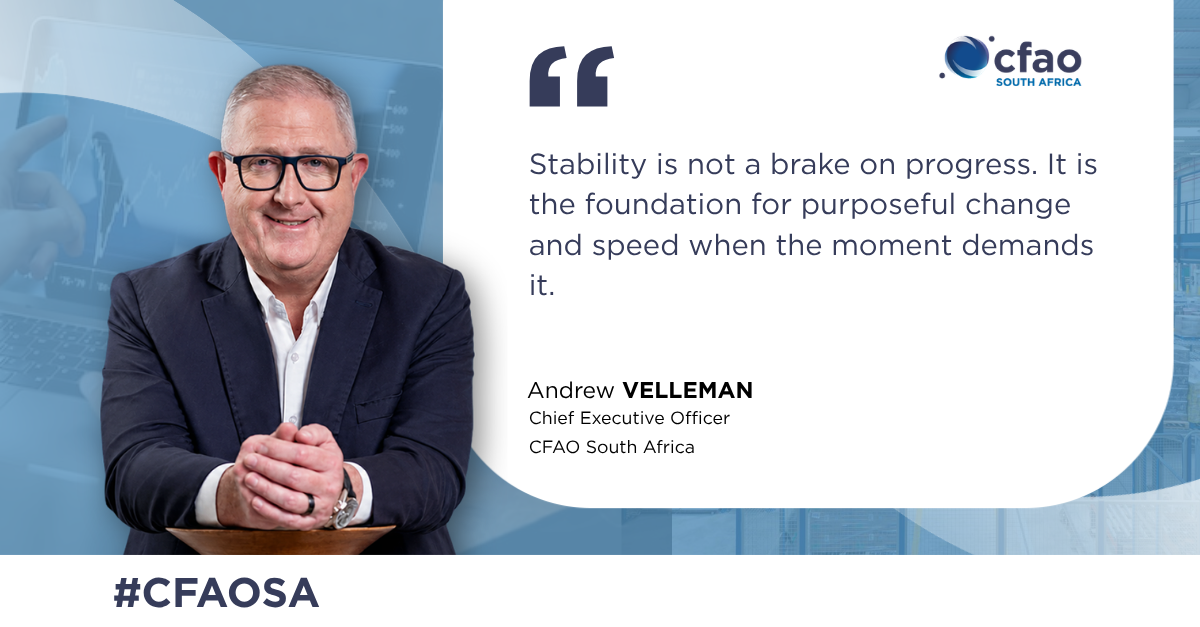
Real agility starts with stability
By Andrew Velleman, CEO, CFAO South Africa
10 November 2026
Business leaders are under constant pressure to move faster. Competitors announce new innovations, technologies reshape expectations, and management trends promise to transform the way organisations work. In that environment, taking time to think can easily be mistaken for falling behind.
No organisation can afford to ignore change. Yet constant movement is not the same as progress. When every development demands an immediate response, businesses risk reacting to the noise rather than making deliberate decisions about where they are going and why.
This is particularly relevant in South Africa, where businesses are accustomed to operating under economic pressure, infrastructure constraints, regulatory change and shifts in consumer behaviour. Add rapid technological advancement and global uncertainty, and the temptation to respond to everything at once becomes even stronger.
What I have learned is that stability is not the opposite of agility. It enables agility. A business with a clear purpose, trusted leadership and consistent principles can respond quickly without losing its identity, unnecessarily disrupting its people, or abandoning what already works.
Stability creates the confidence to move
Speed is often treated as a measure of competitiveness. Yet the first organisation to respond to a trend is not necessarily the one that will benefit most. Genuine agility comes from knowing what can change, what should not, and how a new decision supports the organisation’s longer-term direction.
Clarity matters most when people are surrounded by uncertainty. Colleagues do not expect leaders to predict every development, but they do need to understand where the organisation is headed, what is expected of them and which principles will continue to guide decisions. When those fundamentals are clear, people are better able to adapt, solve problems and act with confidence.
Trust is central to this. When colleagues see consistency between what leaders say and what they do, they are more willing to engage with change, challenge assumptions and suggest improvements. Stability is therefore not passive; it reduces friction and gives organisations the confidence to move forward.
At CFAO South Africa, we have seen this principle in practice. During difficult trading periods, we have continued to invest in our colleagues because capability, confidence and culture cannot be rebuilt simply when conditions improve. Across a diverse group of subsidiaries, consistent leadership and communication provide a common reference point, while each business retains autonomy to respond to its customers, markets and operating realities. This balance allows our businesses to move decisively while remaining aligned with a clear group direction.
Not every trend deserves a reaction
Artificial intelligence is one example of why organisations need a stable strategic reference point. Its potential is significant, but the intensity of the conversation around it can make adoption seem like an objective in itself. The test should not be whether a technology is fashionable, but whether it solves a real problem, improves an experience, increases efficiency or unlocks sustainable value. Its benefits should ultimately be reflected in better decisions and meaningful support for colleagues, rather than adoption for its own sake.
Sometimes the right response is to move quickly. Sometimes it is to test, learn and scale gradually. At other times, the right decision is not to pursue a trend at all. Agility is not the ability to react to everything; it is the ability to make the right move at the right time, with a clear understanding of the value it should create.
Clarity turns stability into action
Stability is built through everyday consistency: in leadership behaviour, communication, priorities and the experiences colleagues have within an organisation. People quickly recognise the difference between a business that talks about stability and one that demonstrates it.
If priorities change constantly, messages conflict, or decisions appear disconnected from what leadership has communicated, trust becomes difficult to sustain. When people understand the direction and see consistency between words and actions, they can make decisions closer to the work, respond more quickly, and contribute more confidently.
This does not require leaders to pretend they have certainty when none exists. Leaders may not always have all the answers, but they can be transparent about what is known, consistent about what matters, and clear about the direction of travel. That clarity gives people a reliable basis for action.
Stability provides a reference point. It enables organisations to innovate without chasing every trend, to adapt without abandoning what works, and to grow without losing sight of what made them strong in the first place.
Leadership agility is not measured by how often an organisation changes direction, but by how confidently it can respond without losing sight of its purpose.
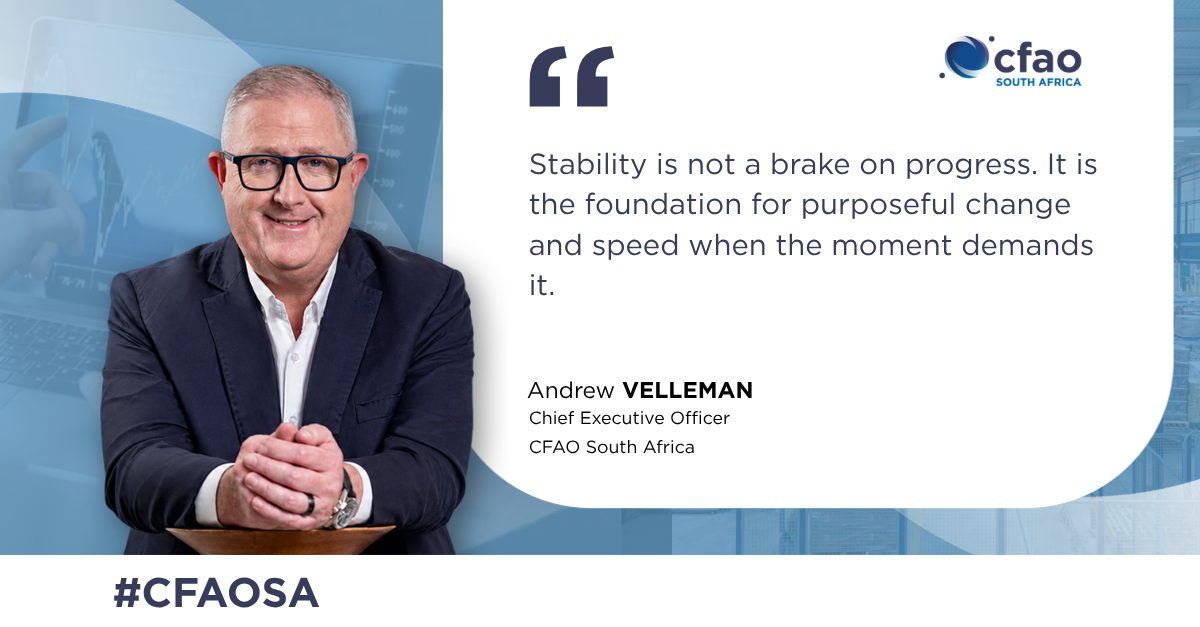
In uncertain times, stability is not a brake on progress. It is the foundation that enables an organisation to change with purpose, act with confidence and move at speed when the moment demands it.
FIN (Word count 790)
EDITORS’ NOTES
ABOUT CFAO SOUTH AFRICA
CFAO South Africa, with more than 7,000 colleagues, offers vehicle and truck sales and rental, supply chain solutions, logistics management, material handling, automotive assembly and the import and export of automotive components. CFAO South Africa delivers an integrated mobility ecosystem. We are a regional division of the CFAO Group, a pan-African business headquartered in France and a wholly owned subsidiary of Toyota Tsusho Corporation in Japan. CFAO South Africa has a strong expansion vision in South Africa in the automotive sector and other sectors aligned to the CFAO Group strategy, including pharmaceuticals and renewable energy. With revenue of more than R30 billion and nationwide operations across more than 160 sites, CFAO South Africa focuses specifically on the integration and transformation of the mobility value chain, manufacturing and localisation in the industry, digitalisation and OEM collaboration, and a multi-brand focus.
PRIMARY CONTACTS FOR MORE INFORMATION OR INTERVIEWS
- Visit the news portal for dedicated media use at https://news.stone.consulting
- Visit the website at https://cfao.co.za/latest-articles/
- The CFAO SA media liaison team on media@stone.consulting / +27 11 447 1068
- Viviana Koshiaris, head of communication of CFAO SA on vkoshiaris@cfao.com / +27 82 342 7390
- Willem S Eksteen, CE of Stone, on willem@stone.consulting / +27 83 272 6304
Click here to downlaod the Word version of this article for easy media use
DOCX - 2.7 Mb
Click here to download the image used in the article
PNG - 470 Kb
Click here to download a high-res image of Andrew Velleman
JPG - 3.3 Mb